Debt Servicing vs Health in Nigeria's 2026 Budget
An English long-form explainer on how debt servicing compares with health funding in the 2026 federal budget.
Nigeria’s 2026 Budget Exposes Stark Divide Between Debt Servicing and Health Investment
By Adekunle Adelowo, March 2026
Nigeria’s proposed 2026 federal budget lays bare a deepening rift in national priorities—where servicing burgeoning debts far outpaces critical health spending, despite persistent promises and regional commitments. As the country wrestles with competing fiscal demands, lawmakers face mounting calls for clarity and accountability in how public funds are allocated.
Debt Servicing Dominates Nigeria’s 2026 Federal Budget
Unveiled in December 2025, President Bola Tinubu’s proposed federal budget sets total projected expenditure at a record ₦58.18 trillion. Among all spending categories, debt servicing towers above most others—commanding ₦15.52 trillion, or approximately 26.7% of the budget. In stark contrast, health care, a vital sector for Nigeria’s 200 million citizens, receives ₦2.48 trillion—a mere 4.2% of overall spending.
This allocation underscores the profound fiscal pressure imposed by debt repayments, even as nominal health spending inches upward in line with overall budget growth. The government’s prioritization is unmistakable on paper.
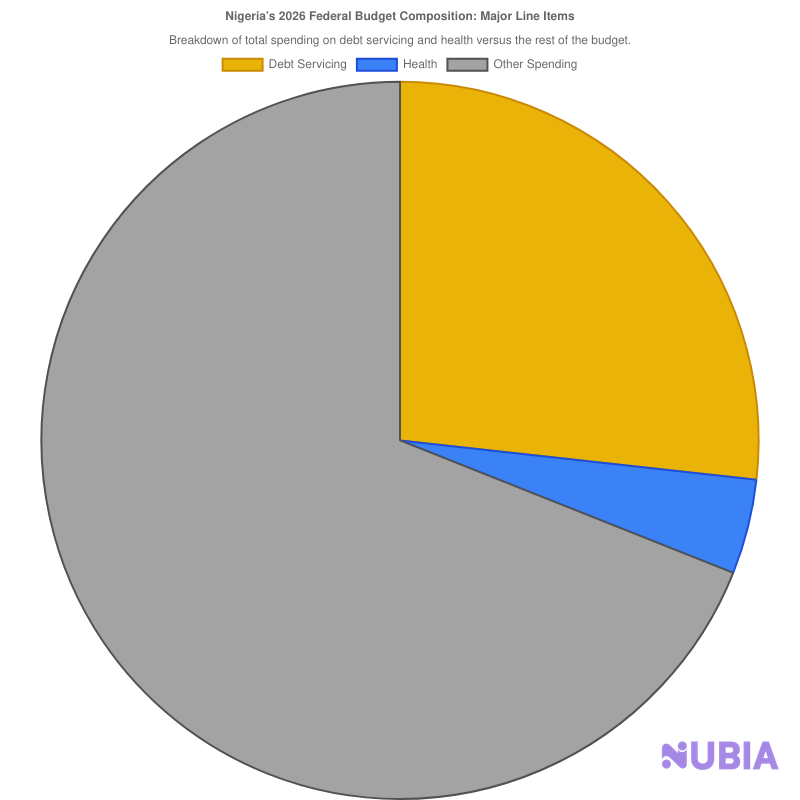
As depicted in the chart above, debt servicing not only dwarfs health allocations, but also outstrips most other recurring and capital expenditures. The result: more than one in every four naira spent by the federal government is earmarked for debt.
“Debt servicing is a dominant line item, consuming over a quarter of the 2026 budget.”
Health Spending: Aspirations versus Reality
This isn’t the first time Nigeria’s health budget has fallen short of international and regional expectations. In 2001, the Abuja Declaration saw Africa’s leaders—including Nigeria’s—pledge at least 15% of national budgets to health. Yet, two decades on, that benchmark remains painfully out of reach. Over successive administrations, health spending has hovered between 3% and 6% of annual outlays.
In the 2026 budget, public health receives only 4.2%—a backward slide from 5.5% in 2025 and 4.6% in 2024. Even President Tinubu’s own election promise to reach a 10% health spending target remains unfulfilled. The administration’s recent claims—that health expenditure equals 6% of the budget “net of liabilities”—have done little to convince critics, as actual figures paint a different picture.
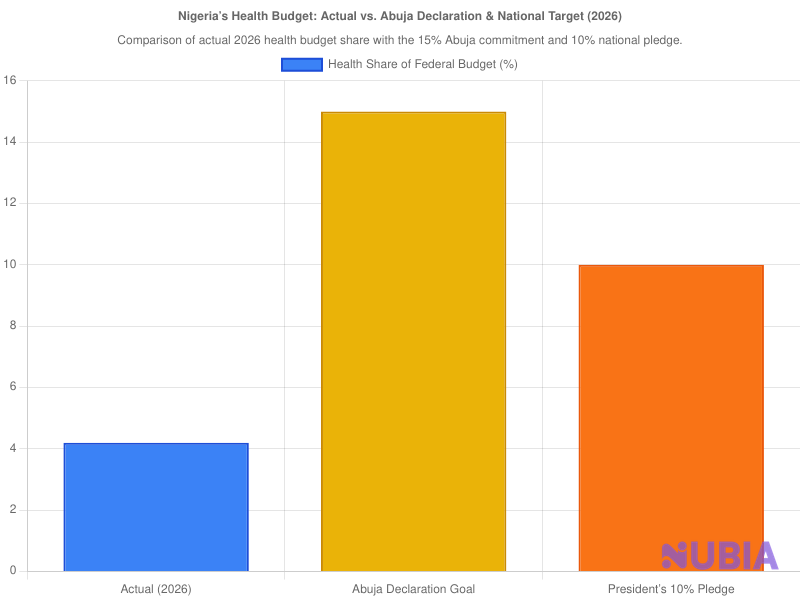
The comparison makes the disparity clearer: health spending in 2026 is less than one-third of the Abuja target, and less than half the president’s own stated ambition.
“Nigeria continues to fall short of continental commitments like the 15% Abuja benchmark and unfulfilled national promises to reach 10%.”
Tracking Health Budget Trends: Hope or Hollow Progress?
A closer look at Nigeria’s health budget trajectory over the last three years reveals that gains in absolute terms are consistently undermined by broader, faster-growing financial obligations elsewhere—chiefly debt. Instead of progressing toward the Abuja Declaration target or the 10% national commitment, the figures have stagnated or regressed.
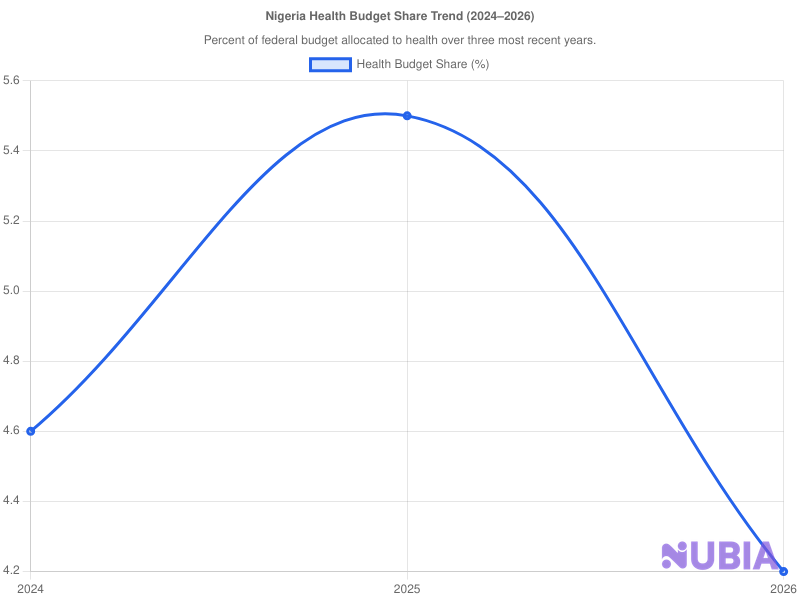
The trend chart above illustrates a persistent pattern: health’s share of the budget has fallen despite rhetorical support and rising total budget envelopes.
“Health spending remains modest, representing just over 4% of total allocation despite increasing in nominal value.”
What the Law and Pledges Require
Nigeria’s budgetary aspirations aren’t solely a matter of politics—legal and global commitments are in play. The 2001 Abuja Declaration’s 15% health allocation pledge remains unmet. No enforceable national law currently mandates a minimum percentage for health, though the president’s unmaterialized pledge to reach 10% still hangs over current and future budget cycles.
Meanwhile, the government’s claims that health receives a higher share when calculated “net of liabilities” have raised eyebrows. By subtracting debts and other recurring obligations before calculating health’s portion, officials present a rosier statistic—but critics argue transparency requires sticking to all-in totals.
“The government’s claim of 6% health spending ‘net of liabilities’ aims to cast health spending in a more favorable light but lacks clarity without supporting calculations.”
Key Findings
- Debt servicing absorbs 26.7% of Nigeria’s 2026 federal budget, outpacing all but the most essential line items.
- Health accounts for just 4.2%—a drop from recent years, and well below Abuja Declaration or national promises.
- National and continental targets for health remain unmet, with little sign of future compliance.
- Transparency issues persist regarding official claims of higher health spending based on “net” calculations.
Beyond the Numbers: Accountability and Priorities
The 2026 federal budget’s numbers reflect a stark calculus: as debt repayments rise and the economy strains to keep pace, vital sectors like health are increasingly crowded out. The result is not only a statistical shortfall, but a practical one—where funding for hospitals, disease prevention, and health worker training remains insufficient for population needs.
In this context, observers and advocates alike argue for new governance approaches—especially when it comes to fiscal transparency and delivery of public promises. Many urge that health spending can’t just be an accounting exercise; it must be a moral and strategic choice.
Conclusion
Nigeria’s 2026 budget stands as a pivotal case study in the growing tension between fiscal constraints and social investment. With nearly 27% of public funds tied up servicing debts, sectors essential for national wellbeing—such as health—are crowded out. Bridging the gap between budget promises, continental commitments, and allocations on the ground will require transparent accounting, renewed political will, and sustained public advocacy. Until then, the numbers tell a sobering tale: debt burden trumps health, at a cost Nigeria can ill afford.
Sources: statehouse.gov.ng 2026 Budget Speech, allafrica.com reporting, BusinessDay Nigeria, Abuja Declaration Wikipedia. Data visualizations verified against official federal budget documents and cited media coverage.