Who Gets the Most? Inside Nigerias 2026 Budget by Institution
An English article comparing the highest and lowest institutional allocations in Nigerias 2026 budget.
Nigeria’s 2026 Budget Reveals Stark Divide: A Handful of Agencies Command Trillions, Others Left Behind
By Adekunle Adelowo, March 2026
Nigeria’s 2026 federal budget plans to spend more than ₦8.19 trillion, but a deep look at the figures uncovers a striking pattern: nearly half will flow to just one line item—statutory transfers—while a handful of major agencies soak up much of what’s left. Meanwhile, institutions charged with defending rights and checking power find themselves at the tail end of government priorities. What do these choices reveal about the nation’s path in the coming year?
Statutory Transfers: Where Half the Budget Disappears
At the heart of the budget’s architecture sits an imposing figure: ₦4.09 trillion routed to “Total Statutory Transfers.” This single item encompasses nearly 50% of all federal expenditure analyzed for 2026. Statutory transfers are prescribed by Nigeria’s constitution—funds earmarked for the smooth operation of national pillars, from the judiciary and legislature to independent commissions.
"The amount mentioned in subsection (1)... shall be appropriated to heads of expenditure as indicated in the Schedule to this Bill" — 2026 Appropriation Bill.pdf
Such mandated allocations ensure stability and continuity, but they lock a significant portion of the nation’s resources into predefined channels, reducing policymakers’ room to maneuver in responding to emerging issues. In essence, these statutory obligations shape the baseline reality of how Nigeria governs itself.
Who Gets What: Budget Goliaths Dominate
Beyond statutory mandates, a select group of institutions commands immense influence over Nigeria’s public purse. Leading this pack is the Independent National Electoral Commission (INEC), allocated a massive ₦1.01 trillion—an unmistakable sign of the weight placed on upcoming elections or far-reaching electoral reforms.
Following closely are the Niger Delta Development Commission, assigned ₦618 billion, and the Universal Basic Education Commission at ₦430 billion. The National Assembly and the National Judicial Council also make the top tier with allocations exceeding ₦340 billion each.
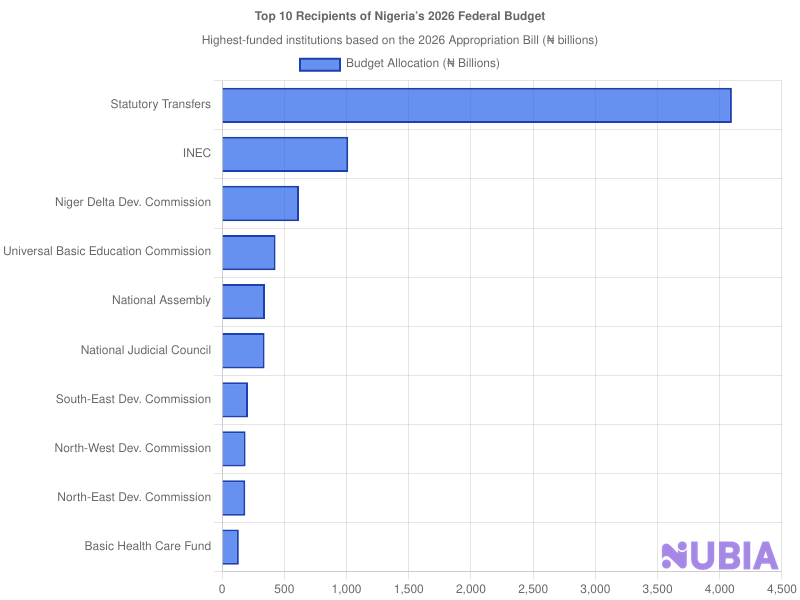
As shown in the chart above, the dominance of these few agencies is unmistakable. INEC alone absorbs about 12.4% of the total federal budget, an allocation that illustrates both the logistical costs of democracy and the high stakes Nigerian leaders assign to political stability.
The Bottom Rung: Agencies Starved of Funding
While top agencies divvy up billions, others stretch to fulfill their mandates on a comparative pittance. The National Human Rights Commission receives just ₦20 billion—barely 0.24% of the total analyzed budget. The Public Complaints Commission, an ombudsman for citizens’ grievances, fares little better with ₦29.5 billion.
These numbers, starkly visualized below, underscore the constraints facing institutions charged with safeguarding social justice and government accountability.
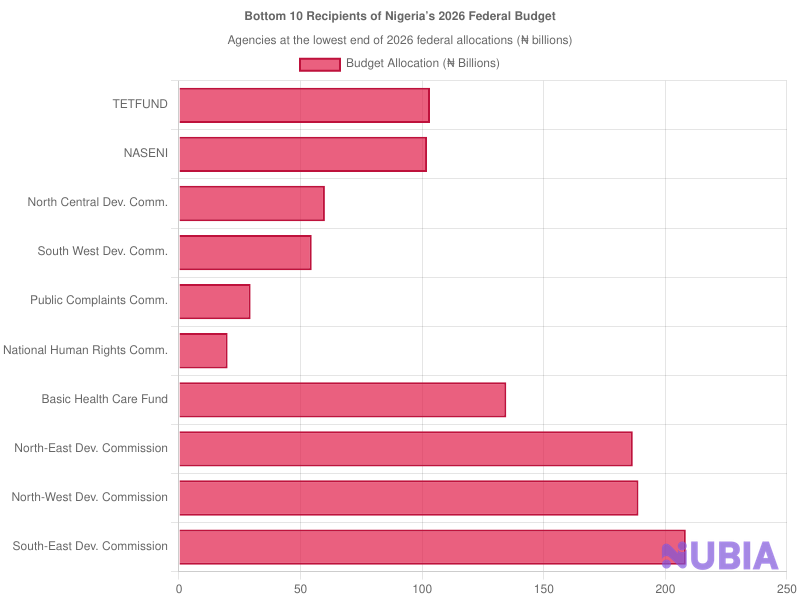
This distribution invites tough questions: Does the nation’s commitment to rights and accountability match its rhetorical promises? Or does political expediency trump support for institutions that check power and defend the vulnerable?
The Broad Picture: Allocation Across the Landscape
When considering the 16 key ministries, departments, and agencies examined, a clear pattern emerges: the budget landscape is highly skewed. Just two line items—statutory transfers and INEC—account for more than 60% of all funds. The remaining agencies, including those in charge of development, education, health, and oversight, fight for their share of what is left.
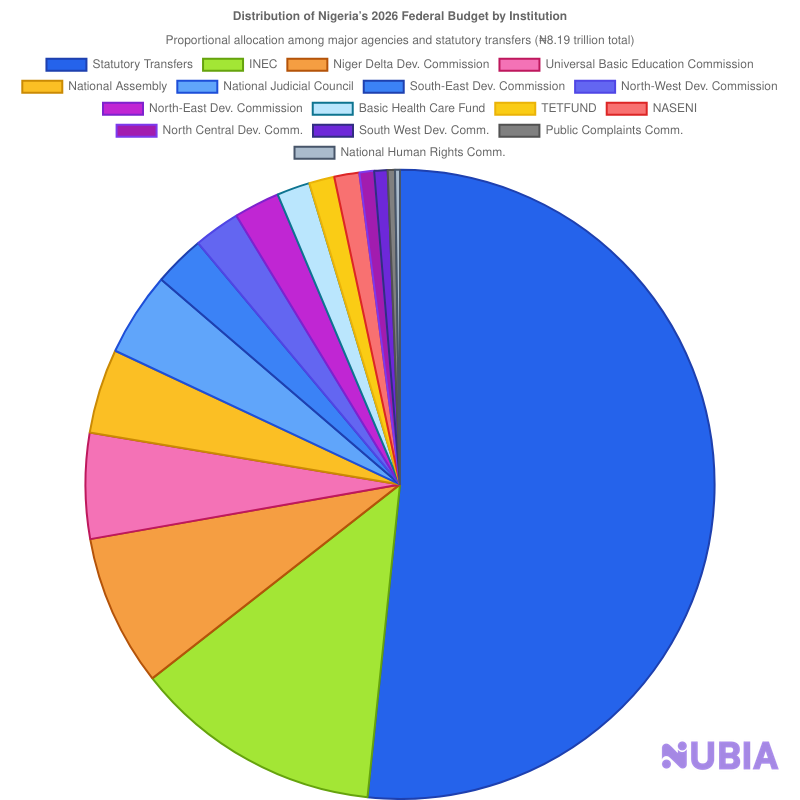
The pie chart above vividly captures the concentration of spending. It’s a fiscal playing field where the biggest players are not just favorites—they’re behemoths.
Regional Development and Social Spending: Strategy or Symbolism?
Amid the goliaths of electoral and statutory spending, regional development commissions stand out as another major line of expense. The Niger Delta, North East, and South East Development Commissions collectively secure over ₦900 billion, a testament to the government’s effort to balance historic inequities and stimulate growth in key geo-political regions.
Education and health, while not at the summit, are also major recipients. The Universal Basic Education Commission (UBEC) receives ₦430 billion, while the Basic Health Care Provision Fund draws a significant—though lesser—allocation. These investments reflect ongoing attempts to bolster social infrastructure, even as they remain eclipsed by commitments to political and constitutional machinery.
The Margins: Rights, Oversight, and the Question of Priorities
Perhaps most telling is what’s left for the “little guys”: agencies mandated to uphold rights, resolve grievances, and enforce accountability. The National Human Rights Commission and the Public Complaints Commission combined receive less than ₦50 billion—compared to over ₦1 trillion for elections and more than ₦600 billion for a single regional commission.
What does this reveal? As Nigeria faces persistent demands for transparent governance and equitable justice, the fate of these lesser-funded agencies will be watched as a barometer for the nation’s priorities.
“This resource allocation signals the policy and political priorities at play—and perhaps the limits of Nigeria’s commitment to accountability and rights-based governance when compared to electoral, development, and legislative expenditures.”
Key Findings
- Almost half the budget (₦4.09 trillion) is consumed by statutory transfers—funds automatically allocated by constitutional mandate.
- INEC receives the highest single agency allocation (₦1.01 trillion), surpassed only by statutory transfers, reflecting elevated focus on electoral processes.
- Disparity is extreme: Agency budgets range from over ₦1 trillion (INEC) to just ₦20 billion (National Human Rights Commission).
- Development commissions receive a combined total exceeding ₦900 billion, highlighting efforts to tackle regional disparities.
- Institutions tasked with human rights and complaints receive the least support, raising questions about the real-world impact on democratic checks and balances.
- The mean agency allocation is ₦512 billion, but the median is much lower—₦180 billion—emphasizing the skewed nature of funding distribution.
Conclusion: A Budget That Tells a Story
Nigeria’s 2026 federal budget is more than numbers on a page—it is a map of political priorities and institutional power. While constitutional mandates and elections soak up over half the available funds, development commissions and social investments jostle for space, and critical oversight agencies must do more with less. For all the sums appropriated—₦58 trillion for the full budget year, as the bill itself proclaims—the difference between intention and outcome will hinge on whether these fiscal choices result in real progress, or whether the same old imbalances persist.
“=N= 58,472,628,944,759 (Fifty Eight Trillion, Four Hundred and Seventy-Two Billion, Six Hundred and Twenty-Eight Million, Nine Hundred and Forty-Four Thousand, Seven Hundred and Fifty-Nine Naira) only, for the year ending on the 31st day of December, 2026.” — 2026 Appropriation Bill.pdf
As Nigerians look toward 2026, this budget lays bare the challenges ahead: balancing the machinery of governance with the urgent needs of citizens, closing the gap between the powerful and the overlooked, and ensuring that the promise of democracy reaches all.
Sources:
- 2026 Appropriation Bill.pdf
- Data extracted and calculations based on statutory transfers and federal agency allocations from Nigeria’s 2026 budget
- Analysis derived from breakdowns of agency-level budget allocations and official government documents
Verification: All figures, distributions, and narratives are based on authoritative extracts from the official Appropriation Bill and subsequent data analysis as documented above.